FDA Cleared, last investigation 02-08-2024

Archive

Product Type: Alloys

Non-Precious Cobalt Chrome 66% Co, 27% Mo, 6% Others, Unique 255 Vick. Hardness

ALLOYS

Non-Precious Cobalt Chrome, suitable for PFM or Full Contour

66% Co, 27% Mo, 6% Others, Unique 255 Vick. Hardness

SMCoCr is a clinically proven cobalt-based ceramic alloy demonstrating outstanding properties.
Advantages
Indications
Composition
  Co 66
Cr 27
Mo 6
Si < 1.0, Mn < 1.0
Technical data
Type
4
Color
White
Density (g/cm³)
8.4
Melting range (°C)
1307 – 1417
Melting point (°C)
1467
Modulus of Elasticity (GPa)
233
CTE (25 – 500 °C) 14.3 x 10⁻⁶ K-1
14.3
Elongation (%)
11.0
Vickers hardness (HV10)
255
Maximum load strength (MPa)
678

Handling Instructions

Lightly sandblast the entire surface of the framework upon receipt. This step is intended to simply create a clean surface to begin working with.

ONLY AREAS REQUIRING ADJUSTING NEED FINISHING.

Perform finishing with dedicated burs or non-contaminating stones. ALL OTHER SURFACES CAN SIMPLY BE SANDBLASTED. IT IS NOT NECESSARY TO PERFORM TRADITIONAL METAL FINISHING ACROSS THE ENTIRE SURFACE.

When finishing steps are completed, sandblast the surface using non-recycled 110µ TO 150µ AL2O3 at max. 36 to 43 PSI or 2.5 / 3 bar pressure then clean in ultrasonic or with steam.

Oxidation

Oxidize at 950°C – 980°C for 5 minutes under vacuum. Oxidation high temperature is 10° higher than your opaque cycle high temp.

Opaque

Do not use a bonder. Ideal opaque coverage may require three applications. Follow this with standard body and incisal porcelain application and glazing per your porcelain kit instructions.

Ready to Get Started?

Join the labs across the US who trust Strategy Milling to deliver consistent results case after case.


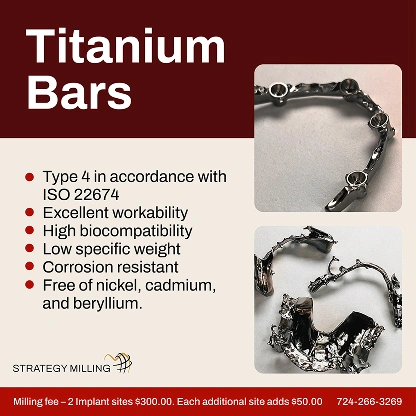
Titanium Grade 23 90% Ti, 6% V, 4% Others, Highly Biocompatible Type IV

ALLOYS

Titanium Grade 23

90% Ti, 6% V, 4% Others, Highly Biocompatible Type IV 

Advantages
Indications
Composition
Ti 90.0
Al 6.0
V 4.0
Fe < 1.0
Technical data
Solidus-liquidus temperature
1605 -1660°C
Melting point
1710°C
Density
4426 g/cmc
Vickers hardness
312 HV10
Percentage elongation at fracture
14%
Yield load strength (Rp0.2)
(Rp0.2) 880 MPa
Modulus of elasticity
114 GPa
Color
White

Ready to Get Started?

Join the labs across the US who trust Strategy Milling to deliver consistent results case after case.


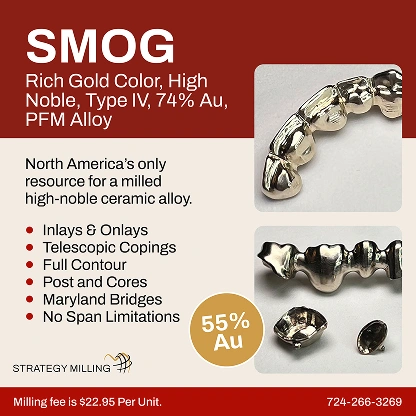
Ceramic – PFM High Noble SMOG 77% Au, Type IV For Porcelain Application

ALLOYS

Ceramic - PFM High Noble

SM-OG Yellow Color, High Noble, Ceramic Alloy, Type IV

Currently Unavailable

Gold based ceramic alloy for dental applications

Indications
Composition
Au 74
Ag 9
Pt 8.6
Pd 5.2
In 2.5
Mn < 1.0, Ru < 1.0
Technical data
Type
4
Color
Yellow
Density (g/cm2)
16.7
Melting range (°C)
1170 – 1335
Modulus of Elasticity (MPa)
97.000
CTE 25 – 500 °C
14.1
Elongation (%)
33.0
Vickers hardness
260
0.2% proof stress (MPa)
525

Handling Instructions

PLEASE READ BEFORE MAKING ANY MODIFICATIONS TO THE FRAMEWORK!

Before modifying the surface with any grinding, sandblast the part with non-recycled 50–100-micron AL2O3 at max. 65 psi pressure. Avoid inhalation of dust! The surface must be clean of any potential contaminates prior to modifying.

ONLY AREAS IN NEED OF ADJUSTING NEED METAL FINISHING. The whole surface does not require refinishing.

Perform desired finishing with dedicated carbide burs or non-contaminating stones such as grinding instruments categorized as non-contaminating, having ceramic binders. ALL OTHER SURFACES CAN SIMPLY BE SANDBLASTED. IT IS NOT NECESSARY TO PERFORM TRADITIONAL METAL FINISHING ACROSS THE ENTIRE SURFACE.

When finishing steps are completed, sandblast the surface using non-recycled 50–100-micron AL2O3 at max. 65 psi pressure.

Oxidation

Clean using distilled H2O in an ultrasonic, or steam clean and dry the part free from any water residue. Place the framework on firing trays providing stable support. Do not touch the dried surface. Begin firing at 650C/1200F, increasing the temperature to 950C/1740F under full vacuum with 5-minute hold at the high temperature.

Opaque

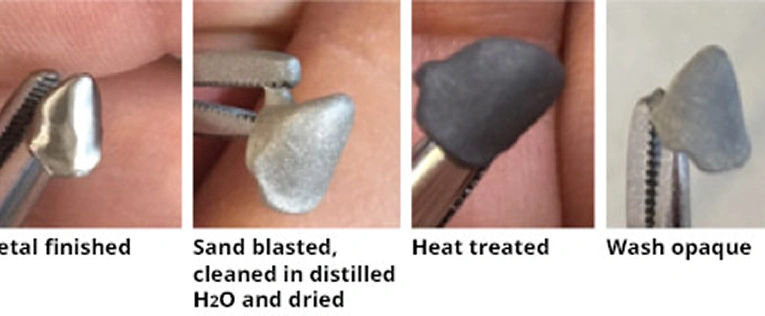
The first layer of opaque MUST BE A VERY THIN WASH COAT as seen below. Failure to perform this step as described is a likely cause of bubble formation at later stages. Ideal opaque coverage may require three applications. Follow this with standard body and incisal porcelain application and glazing.

Recommended Ceramic Material

IPS Style®, IPS InLine®, One, IPS InLine®, PoM, IPS Classic®, IPS d.SIGN®

Solders and Fluxes

Design the soldering patty as small as possible and preheat it in the furnace at approximately 600°C/1112°F. The soldering gap should be the same thickness as the soldering strip. Allow the object to cool slowly after soldering. Use flux very sparingly.
Pre-Solder
HGPKF 1015Y, High-Fusing Bondal Flux
Post-Solder
.615, .585 Fine Gold Solder, Bondal Flux
Laser weld material
Laser Ceramic Yellow PdF

Polishing

After glazing remove oxide and flux residue and finish/polish the framework with rubber finishers/polishers.

Indications

Onlays, 3/4 crowns, crowns, telescope crowns, conus crowns, posts, short and long span bridges, bars, attachments, implant superstructures, partial dentures.

Contraindications

For patients with known allergy/sensitivity to any major or minor constituents of this alloy, consultation with a physician is recommended.

Side Effects

In individual cases, sensitivity, or allergies to components of this alloy may occur.

Interactions

Galvanic effects may occur between different alloys in the same oral environment.

Ready to Get Started?

Join the labs across the US who trust Strategy Milling to deliver consistent results case after case.


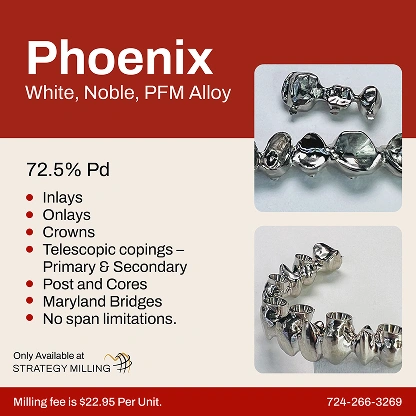
Ceramic – PFM Nobl Phoenix PXN 76% PD, Type IV For Porcelain Application

ALLOYS

Ceramic - PFM Noble

Phoenix N - PXN Silver Color, Noble Type IV Ceramic Alloy

Pd based ceramic alloy for dental applications

Indications

Composition

Pd 72.5
Ag 7
Au 6.5
In 6
Ga 6
Re < 1.0
Technical data
Type
4
Color
White/Silver
Density (g/cm2)
11.73
Melting Range (Solidus/Liquidus)
1270 – 1310°C
Modulus of Elasticity (MPa)
97.000
CTE 25 – 500 °C
13.8

Handling Instructions

Product Description

Pd-based, Type 4, metal-ceramic dental alloy.

PXN Handling Instructions

PLEASE READ BEFORE MAKING ANY MODIFICATIONS TO THE FRAMEWORK!

Before modifying the surface with any grinding, sandblast the part with non-recycled 50–100-micron AL2O3 at a maximum of 65 psi pressure. Avoid inhalation of dust! The surface must be clean of any potential contaminants before modification.

ONLY AREAS IN NEED OF ADJUSTING NEED METAL FINISHING. The entire surface does not require refinishing.

Perform desired finishing with dedicated carbide burs or non-contaminating stones such as grinding instruments categorized as non-contaminating, having ceramic binderss. ALL OTHER SURFACES CAN BE SANDBLASTED. IT IS NOT NECESSARY TO PERFORM TRADITIONAL METAL FINISHING ACROSS THE ENTIRE SURFACE.

When finishing steps are completed, sandblast the entire surface using non-recycled 50–100-micron AL2O3 at a maximum of 75 psi pressure. Using steam or ultrasonic methods, clean the framework with distilled water or ethanol and allow it to dry.

Oxidation

Clean using distilled H2O in an ultrasonic, or steam clean and dry the part free from any water residue. Place the framework on firing trays providing stable support. Do not touch the dried surface. Begin firing at 540C/1000F, increasing the temperature to 950C/1740F without vacuum with a 1-minute hold at the high temperature.

Opaque

The first layer of opaque MUST BE A VERY THIN WASH COAT as seen below. Failure to perform this step as described is a likely cause of bubble formation at later stages. Ideal opaque coverage may require three applications. Follow this with standard body and incisal porcelain application and glazing.

Polishing

After glazing remove oxide and flux residue and finish/polish the framework with rubber finishers/polishers.

Indications

Inlays, Onlays, 3/4 Crowns, Crowns, Telescope Crowns, Conus Crowns, Posts-Cores, Bars, Short and Long Span Bridges, Bars, Implant Retained Superstructures, Partial Dentures.

Contraindications

Consultation with a physician is recommended for patients with known allergy/sensitivity to any major or minor constituents of this alloy. This material is not recommended for any application not within the indications listed.

Side Effects

In individual cases, sensitivity, or allergies to components of this alloy may occur. Strategy Milling makes no claims regarding the MRI compatibility of its dental alloys. The patient must be made aware of the possibility that dental alloys may affect MRI results and disclose the presence of dental alloys to the MRI Technician before tests are performed.

Interactions

Galvanic effects may occur between different alloys in the same oral environment.
Caution

Vapors and metal dust are harmful if inhaled. Please use extraction equipment and PPE when working with this material.

Disclaimer

This material has been developed solely for use in dentistry. Processing should be carried out strictly according to the Instructions for Use. Strategy Milling cannot be held liable or accept responsibility for damages resulting from failure to observe the Instructions or the stipulated application area. The user is responsible for testing the products for suitability and use for any purpose not explicitly stated in the Instructions. These regulations also apply if the materials are used in conjunction with other manufacturers’ products.

Ready to Get Started?

Join the labs across the US who trust Strategy Milling to deliver consistent results case after case.


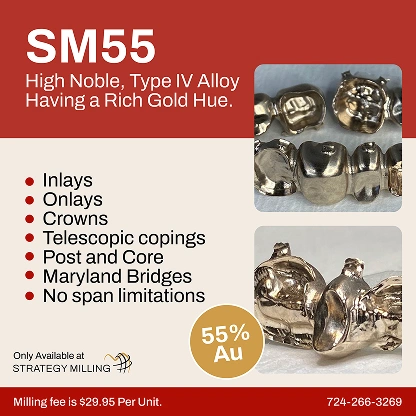
Gold Crown and Bridge High Noble SM55 – 55% Au, Type IV

ALLOYS

Gold Crown and Bridge High Noble

SM55 - 55% Au High Noble Crown and Bridge Alloy, Type IV

SM55 is a clinically proven reduced gold crown and bridge alloy demonstrating outstanding properties.
Advantages
Indications
Composition
Au 55.0
Pd 5.2
Ag 30.0
Cu 9.0
In < 1.0, Ir < 1.0
Technical data
Type

4

Color
Yellow
Density (g/cm2)
13.6
Melting range (°C)
905 – 975
Casting temperature (°C)
1030 – 1090
Modulus of Elasticity (MPa)
83.000
Elongation (%)
19.0
Vickers hardness
185
0.2% proof stress (MPa)
425

Ready to Get Started?

Join the labs across the US who trust Strategy Milling to deliver consistent results case after case.


Gold Crown & Bridge Noble SM20 – 20% Au, Type IV

ALLOYS

Crown & Bridge Noble

SM20 - 20% Au, Noble Crown and Bridge Alloy, Type IV

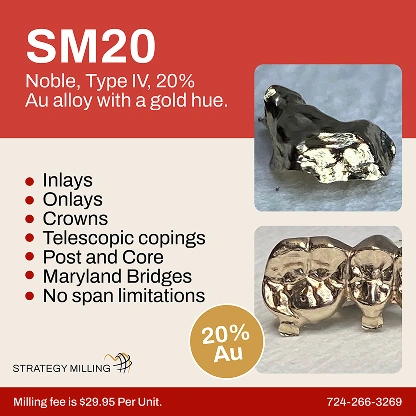
SM20 is an economic golden crown and bridge alloy from Strategy Milling. It is suitable for full-cast crowns and bridges, inlays, and onlays.

Advantages
Indications
Composition
Ag 40.75
Au 20.0
Pd 14.0
In 11.0
Cu 10.75
Sn 2.0
Zn 0.5, Pd 1.0, Ru 1.0
Technical data
Type
Noble
Color
Yellow
Density (g/cm³)
10.8
Melting range (°C)
750 – 840 C
Casting temperature (°C)
960 – 1020 C
Modulus of Elasticity (MPa)
90
Elongation (%) – As cast
5
Vickers hardness – As cast
195
0.2% proof stress (MPa) – As cast
195
Tensile Strength (MPa) – As cast
570

Polishing Recommendations

This is a Type IV alloy which is hard.
Follow with a new or newer Robinson Soft Bristle Brush using medium pressure and  Fabulustre Polishing Compound, the type for final buffing of Au, Ag, Pt, Al, Ni, Fe, and Cu, (two tone gold colored label).
Short, worn bristle brushes are not great, in my opinion. Follow that up with a soft felt wheel, light on pressure and light on polish.
This combination works very well at leaving a smooth, high shine.

Ready to Get Started?

Join the labs across the US who trust Strategy Milling to deliver consistent results case after case.