Handling Instructions
PLEASE READ BEFORE MAKING ANY MODIFICATIONS TO THE FRAMEWORK!
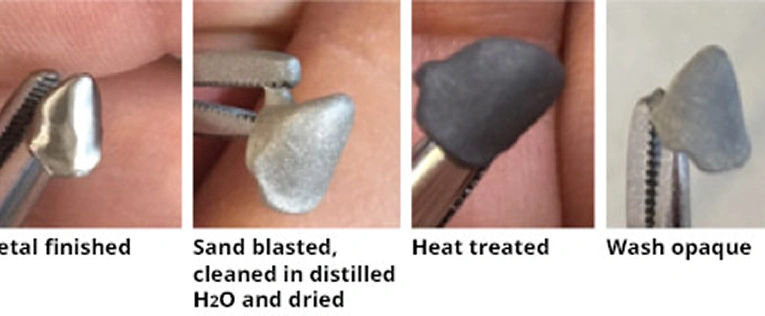
Before modifying the surface with any grinding, sandblast the part with non-recycled 50–100-micron AL2O3 at max. 65 psi pressure. Avoid inhalation of dust! The surface must be clean of any potential contaminates prior to modifying.
ONLY AREAS IN NEED OF ADJUSTING NEED METAL FINISHING. The whole surface does not require refinishing.
Perform desired finishing with dedicated carbide burs or non-contaminating stones such as grinding instruments categorized as non-contaminating, having ceramic binders. ALL OTHER SURFACES CAN SIMPLY BE SANDBLASTED. IT IS NOT NECESSARY TO PERFORM TRADITIONAL METAL FINISHING ACROSS THE ENTIRE SURFACE.
When finishing steps are completed, sandblast the surface using non-recycled 50–100-micron AL2O3 at max. 65 psi pressure.
Oxidation
Clean using distilled H2O in an ultrasonic, or steam clean and dry the part free from any water residue. Place the framework on firing trays providing stable support. Do not touch the dried surface. Begin firing at 650C/1200F, increasing the temperature to 950C/1740F under full vacuum with 5-minute hold at the high temperature.
Opaque
The first layer of opaque MUST BE A VERY THIN WASH COAT as seen below. Failure to perform this step as described is a likely cause of bubble formation at later stages. Ideal opaque coverage may require three applications. Follow this with standard body and incisal porcelain application and glazing.
Recommended Ceramic Material
IPS Style®, IPS InLine®, One, IPS InLine®, PoM, IPS Classic®, IPS d.SIGN®
Solders and Fluxes
Design the soldering patty as small as possible and preheat it in the furnace at approximately 600°C/1112°F. The soldering gap should be the same thickness as the soldering strip. Allow the object to cool slowly after soldering. Use flux very sparingly.
Pre-Solder
HGPKF 1015Y, High-Fusing Bondal Flux
Post-Solder
.615, .585 Fine Gold Solder, Bondal Flux
Laser weld material
Laser Ceramic Yellow PdF
Polishing
After glazing remove oxide and flux residue and finish/polish the framework with rubber finishers/polishers.
Indications
Onlays, 3/4 crowns, crowns, telescope crowns, conus crowns, posts, short and long span bridges, bars, attachments, implant superstructures, partial dentures.
Contraindications
For patients with known allergy/sensitivity to any major or minor constituents of this alloy, consultation with a physician is recommended.
Side Effects
In individual cases, sensitivity, or allergies to components of this alloy may occur.
Interactions
Galvanic effects may occur between different alloys in the same oral environment.